7.29.2011

Skill Assessment: What Is Your Hole #3?

We all have strengths and weaknesses. It is a defining part of the human experience. However, certain weaknesses impact our ability to positively lead others more than others. These weaknesses can become our "Hole #3".

I used to play golf all the time. Ten years ago it wouldn't be uncommon for me to play 50-60 rounds per season. The last few years I was lucky to get 5-6 rounds played per year. 2010 was one of those years.
In October I dusted off the clubs for a round with my great friend and speaking partner, Kelly Barnes. It was a magical round... except for hole #3. It was a great day on the links. All pars and bogeys (great for me), except for one double-bogey and a disaster on hole #3. I scored a 13 on that one hole! It was a train wreck. It was so bad Kelly and I were not even going to score it - hence the scratches. If I had even bogeyed that hole, I would have scored a 79 and achieved something I have only done twice in my golfing career - breaking 80. Needless to say, I ended an otherwise great day of golf very, very frustrated.
As leaders, we are expected to deliver results - i.e. birdies and pars. However, if we have even one glaring weakness or shortcoming (one Hole #3), it can diminish our effectiveness and make many of our strengths irrelevant.

Fortunately, leadership (unlike golf) is a team sport. The best leaders are surrounded with people who are strong where he or she is weak. Yet, a Hole #3 type weakness can still hold us back and block our leadership's full power, scope and range. The following grid shows how you can have 9 of the 10 vital components of great leadership and still fall short of your potential.

Click to view larger version

The abbreviations are the PLI Leadership Essentials.

Examine your skills. Be honest with yourself. What is a weakness you possess that has a Hole #3 type meaningfulness? Find it and begin today working on growing, changing and improving. At the end of the day, a 79 might only be 7 strokes from an 86, but those 7 strokes might mean the difference between being a leader who is an "also played" and a leader who is a game-changer. One that is leaving a legacy of excellence, remarkable results and a life-changing score for those you serve.

7.25.2011

Teaching PLI: The New Blog Label - Teaching PLI


When you have over 300 posts (which are essentially 300 additions to the PLI leadership curriculum), keeping everything organized is very important.  We have added another layer of organization for our PLI teachers and anyone else who reads our blog for the purpose of adding to their leadership teaching or learning!

We have a new label for our posts called Teaching PLI.  This label is applied to any post where the purpose is to give ideas, instruction, clarity of mission or tips/tricks on teaching leadership and specifically teaching the PLI leadership curriculum.  You can quickly access all of these posts by clicking on the Teaching PLI Posts link in the right-hand column. 

Enjoy!

7.12.2011

Fostering Relationships: Watering Dirt


Anyone who has ever tried to motivate someone has experienced this struggle...

"Are we just watering dirt?"

I.e. - can we really do anything, say anything, offer any incentive that will nurture growth in this person or are we just wasting valuable resources?

It is a difficult and frustrating situation to be in. One that causes you to second guess your abilities, your strategies and ultimately your decision to have that person on the team.

When you find yourself in this position, talk through the following points:

1. Everyone has a price. You probably need to change the currency you are using with that person. Is she motivated by money, position, prestige, responsibility, autonomy, appreciation, social status, etc.? Find what works for her that also aligns with what you can give and give it.

2. Everyone needs their best inspired out of them. Even the most cynical person responds to words and acts of encouragement, appreciation and thanks. Some will never tell you, but this doesn't change the fact that it works.

3. Everyone is self-motivated. At the end of the day, people must move on their own. They will also do it on their own timeline. You can mandate her actions, but you can not mandate her BEST actions. (BEST - Better Every Single Time - Source: Kelly Barnes)

4. Everyone needs someone to believe in them more than they do. Sometimes it's a race to see who will give up first. If you throw in the towel before she does, you might miss something special. Give her your best and see what happens.

5. Everyone needs honesty from their leaders. Once you do all you can, if she is still not showing progress or living up to clear expectations, it is time to let her go. This could be just what she needs to make a change. Wake-up calls happen in life and serve as opportunities to see how our actions are pulling us down instead of lifting us up. If you care about her, be honest. Don't pass the buck or let her ignore what everyone can see except for her.

When done correctly and with class and spirit, these concepts will show you it was more than dirt you were watering - an unseen seed was waiting for you to help it grow.

7.11.2011

Goal Processing: Nine Daily Habits of Leaders

Following are nine daily habits leaders use to put action to the Student Impact Model...


1. Quiet time
2. Eat healthy food
3. Physical activity
4. Connect with friends
5. Read positive material
6. Create something
7. Encourage someone
8. Move one step closer to a goal or fixing a problem
9. Help family

Self-audit your life and check to see how many of these habits are evident in your daily routine. Increase your ability to impact others in a big way through these small acts of awesomeness.

6.25.2011

General: 4 Critical Leadership Skills for College Students

1. Build a powerful Failure Factory.

Life isn't fair. We all fall down. If you are a machine built for performance and excellence, your extreme approach to life will create intense highs and intense lows. Thus you need a Failure Factory built to process failure to ensure future success. People are inspired by, careers are built upon and dreams flourish by handling failure and disappointment with grace, patience, a growth perspective, boldness and a willingness to learn and change.

During a period of self-discovery and life changes like the college years, you must attack life with a well-established Failure Factory and put yourself out there regardless of how high or low the chances are for success. Ask for that job, call that recruiter one more time, run for that campus office, send twice as many resumes, etc. Approach the start of your career with zeal and no fear of failure. Life will have plenty of opportunities to try to steal those two things from you later.

2. Work to see things differently.

An approach to life that aids in the creation of a powerful leadership ability is always seeking out the new, the fresh, the unique, and the uncommon in everyday life. Your value in the workplace will seed from many sources. This is one that is hard to relate on a resume, will cause many "workplace veterans" to beat you down and is an extreme career builder. Practice sharpening this skill now. Approach your classes, college-life, job searching, networking, etc. in your own unique way. It is amazing how you see different things when you make an effort to see things differently.

A good example is your relationship with your professors, advisors, and other university personnel. If you wanted a job from me, the first people I would call aren't your references list (everyone white washes those). I would call the campus people who I know have worked with you. I would ask these people questions to learn about your key leadership indicators - work-ethic, social skills, like-ability, problem-solving skills, etc. Many of your peers don't give a second thought to the impression their actions leave on these important people. They skip class, listen to music in class, never seek sage counsel, don't mind their appearance, etc. You should see things differently and understand how many chances you have over the course of your college career to build a network of fans. You may never directly need them, but if you ever do they are huge allies to have.

3. Diligently repeat the Three C's every day.

Aristotle said we are what we do repeatedly. College is such a crazy, busy, fast-moving time that many college students forget to leverage the span of years it covers to slowly build more value than just a diploma. The job market beats down the status quo, but rewards the diligent souls who invest in their abilities. The Productive Flourishing blog did a post in 2009 illuminating three key "daily habits" college students should get into their routine.

Beyond these, there are industry specific items (based on your major) you should be working on. This is where a mentor, job shadowing and/or internships come in handy. You can pick-up clues about certain knowledge-points, competencies, etc. that will come in extra-handy not only on the job, but in the ever-daunting process of landing said job.
4. Be a servant of others.

Leadership at it's best is many things. Leadership at it's core is serving others. Invest time in college helping others (being a friend worth having), serving others (volunteering and/or running for office) and developing the muscles that enables you to lift others higher than yourself. College can be a very self-serving time. Its supposed to be - you are getting yourself built right so you can go out and get hired, start your career and change the world. Thus, it is impressive on many levels when you can travel through this selfish time with a focus on building others. Hopefully, it will be a mission that lasts a lifetime. The benefits of it certainly does.

Good luck and enjoy these days. They will prove to be some of the most spirited of your life.

iPhone users - Grab our free leadership app by searching for pliblog in the app store.

6.13.2011

Service Minded: The Thunder Principle

This is the final post of a series highlighting the 12 Excellent Service Principles.

Thunder Principle
Have one face for the organization.

Our final principle comes straight from the chief customer service conductor of Oklahoma City's NBA team - the Thunder. I called my friend Pete Winemiller and asked him one important question, "What is the primary tool you and your team use to help create the fabulous customer experience at Thunder basketball games?" He said, "We carry one face for the organization."  He went on to explain that no matter who you work for (the Thunder, Coke, Pizza Hut, the NBA, etc.), it is vital for everyone to operate as one team in the arena when interacting with customers.

This principle is especially important for any organization with multiple vendors, project groups, buildings, stores, sites, etc. There is nothing more disheartening for a customer than to hear a team member talk down about or blame a member of their own staff.  It leaves a bad taste in the mouth and does nothing to enhance the organization's image or to improve the customer's experience.

Here are a few ideas on how to put the Thunder Principle into action to create a culture of team-oriented customer service excellence:

  1. Always talk up team members, departments, etc. that aren't present
  2. Move information, people, actions down the line in the most complete fashion possible
  3. Take care of a problem if you can without just passing the buck
  4. Be on time
  5. Do your work
  6. Think about how your actions impact a team member not present
  7. Leave your area/project/etc. clean and prepared for the next crew
The Thunder Principle is the perfect manifestation of excellent customer service because it is based on the thinking that everyone is ultimately on the same team - me, my team mates and my customers. We are all wanting the same thing, we just have different approaches to get there and those differences can cause seemingly unsolvable problems. The "one face" mindset allows us to start on the same team and is the best way to end on the same team, as well!

6.10.2011

Service Minded: The YourSpace Principle

This is part of a series highlighting the 12 Excellent Service Principles.

YourSpace Principle
Your way + My way = Our Way.

The hallmark principle of excellent customer service is being others-focused. This manifests in many ways. One of the most powerful is the mindset of always seeking to understand where the customer is coming from, finding out their point of view, really listening to their opinions and concerns, etc. Then taking that data, combining it with the information you are armed with and acting out the YourSpace Principle - Your way + My way = Our way.

This isn't just pretending to listen for the purpose of making the customer feel heard. The YourSpace Principle is a methodology designed for four purposes:
  1. Leaving the customer feeling appreciated
  2. Gathering useful information from his or her side of the situation
  3. Providing the customer a clear explanation of your side
  4. Moving forward with a plan aimed at satisfying both sides' needs
Better information, empowered customers, collaborative decisions - all winning outcomes for excellent customer service interactions.

Next up, the Thunder Principle - Have one face for the organization...

6.08.2011

Service Minded: Walking Billboard Principle

This is part of a series highlighting the 12 Excellent Service Principles.


Walking Billboard Principle
You are the brand.

This is one of the simplest customer service principles to understand and one of the most difficult to pull off successfully and completely. The Walking Billboard Principle states, "You are the brand." This means that when the customer interacts with you, the are essentially interacting with your entire organization. If they like you, they like your company. If they are upset with you, they are upset with the institution. And vice-versa. They might be frustrated with you, even it is your company they are frustrated with.

This principle illuminates the fact that you must always be mindful of your words and actions. They don't live in a silo - isolated from making an impact beyond that one situation. They have a long tail. This is another reason why great customer service organizations are surgical when it comes to hiring people whose values and beliefs align with the organization's values and beliefs. It is easier to "be the brand" when you don't have to fake it.

Up next: The YourSpace Principle - Your way + my way = our way...

6.06.2011

Service Minded: Toyota Principle

This is part of a series highlighting the 12 Excellent Service Principles.


Toyota Principle
Enable and encourage problem solving right now.

Toyota adopted a new set of management principles (under the direction of management guru Peter Drucker) that set out to move away from their old controlling and rigid top-down structure and move closer to a true teamwork system. These changes created a culture of responsibility across all levels and gave each employee the autonomy to decide how to best reach a clear set of objectives. An example is a change on the production line that allowed anyone to stop the line immediately when they caught a mistake. The old way involved paperwork up and down the chain before any action could be taken. 

Are your people empowered to and enabled with the tools to serve your customers to the best of their ability? Do they feel like they can question processes and practices without retribution? Can they solve problems on their own or do they always have to "get permission"? When you enable and encourage problem solving in the moment not only do customers get served better, but your staff takes more ownership.

Up next: The Walking Billboard Principle - You are the brand...

6.03.2011

Service Minded: Toddler Principle

This is part of a series highlighting the 12 Excellent Service Principles.


Toddler Principle
Friendly first.

Our newborn loves to smile. Most babies do. However, our newest little one's frequency, consistency and intensity of her smiles are higher than most. It certainly makes for a fun parenting experience. When she smiles it is nearly impossible to not smile back. This raw, pure interaction serves as a reminder that we were born to smile and the best customer-oriented people live to smile.

Its not always on their face - that's not genuine or natural. However, it is their home base and they start there with customers. The Toddler Principle is about starting with a positive emotion and then moving forward from there. No matter what is going on in your world, when a customer enters into it - stop, make eye contact, smile and give a friendly greeting. It is amazing how many good things show up when you start with friendly first.

Up next: Toyota Principle - Enable and encourage problem solving right now...

6.01.2011

Service Minded: The Fresh Air Principle

This is part of a series highlighting the 12 Excellent Service Principles.


The Fresh Air Principle
Ask great questions.

When I am traveling my primary source of entertainment is my music and podcast library. One of my favorite podcasts is the daily radio interview show Fresh Air. Terry Gross is the host. Rarely does an episode go by without a guest making the comment, "That is a great question, Terry." She (and her team) script out excellent questions that get right to the heart of the matter.

Great customer service professionals love questions. They enjoy it when customers ask questions (because it is a sign of interest and because it provides an opportunity to solve a problem or serve a need for the customer) and they thrive on asking customers questions.  Here is a short list of questions you should be asking regularly:

  • How can we help you today?
  • How are you today?
  • What concerns do you have?
  • How can we make this better for you?
  • What else can we do for you?
  • What questions do you have?
  • How did you hear about us?
Up next, the Toddler Principle - Friendly First...

5.30.2011

Service Minded: The Irving Principle

This is part of a series highlighting the 12 Excellent Service Principles.


The Irving Principle
Get clear on why you are successful.

The Vienna Beef Co. had a problem after they moved into their brand new production center in the Chicago area. Even with 40 years of experience, something was wrong - their hot dogs didn't taste the same. Same spices, same process, different taste. They spent 18 months researching the problem and discovered it was Irving's fault. Their previous plant was a cobbled together chain of old manufacturing buildings in Chicago. Irving was the man who pushed the cart of cold, newly formed hot dogs 30-minutes across the plant to the next step in the process. This trip was unnecessary in the new plant because the two steps were right next to each other for efficiency purposes. The only problem was that Irving's 30-minute walk allowed the dogs to warm up. This proved to be a critical step in creating their signature taste.

The Vienna Beef Co. had enjoyed success for years, but wasn't totally clear on why. Great customer service organizations are infatuated with learning why customers keep coming back. This, obviously, is a major reason why they do.  They understand it, embrace it, train against it and continually adjust for it.

Up next, the Fresh Air Principle - Ask Great Questions...

5.27.2011

Service Minded: The Tony Bennett Principle

This is part of a series highlighting the 12 Excellent Service Principles.


The Tony Bennett Principle
Have a veteran's expertise and a novice's energy.

A common affliction in the world of dealing with customers is atrophy of the attitude. We used to be excited to see customers, but with age/time/experience/challenges/etc. comes a dampened enthusiasm for work and customer interaction. The great standards singer, Tony Bennett, was once asked how he continually gives great performances after years of singing the same songs. He says that even though he has sung I Left My Heart in San Francisco thousands of times live, he imagines (and knows for a fact) that many of his audience members have never seen him sing it live. This allows him to have the energy and presence of a novice even though he has the years and expertise of a veteran. Apply Tony's lesson to your world and treat the 4,056th customer with the same spark and freshness you gave to the first.

Up Next, the Irving Principle - Gain Clarity on What Makes You Successful...

5.25.2011

Service Minded: The Platinum Rule Principle

This is part of a series highlighting the 12 Excellent Service Principles.


Platinum Rule Principle
Do unto others like they'd like done unto them.

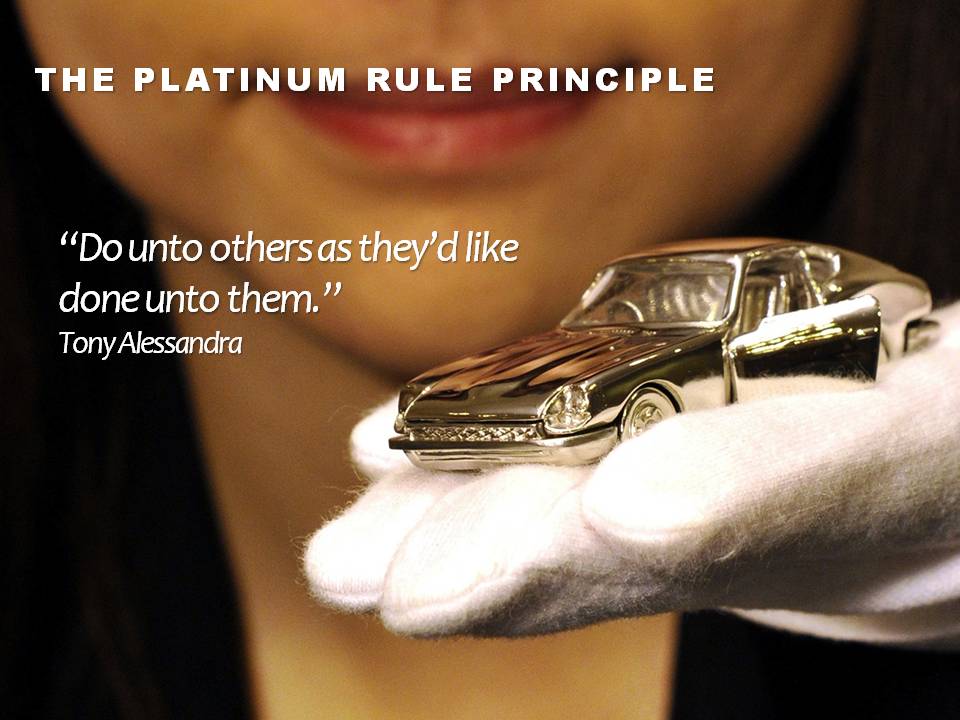
Fellow speaker and leadership consultant, Tony Alessandra, took the golden rule and added some leadership value to it.  He created the Platinum Rule - Do unto others as they'd like done unto them.  Although very important, the golden rule is rooted in " me first - you second thinking".  It states that I will treat you like I want to be treated.  The platinum rule takes the me out of the equation.  It says that I will treat you like you want to be treated because I have taken the time to learn about you and find out how you want to be treated. It is the ultimate act of leadership (being service-minded) and great customer service.

A few ways customer service professionals operate from the Platinum Rule are:  being more aware of others, mirroring body language to put the other person at ease, asking questions to learn about each customer's unique situation, etc.

Personalize.  Customize.  Humanize.

Up next, the Tony Bennett Principle - Have a Veteran's Expertise and a Novice's Energy...

5.23.2011

Service Minded: The Open Space Principle

This is part of a series highlighting the 12 Excellent Service Principles.

Open Space Principle
Build on what works.

A marriage counselor was working with an overly negative woman. She had a laundry list of her husband's faults and would focus on them every session. The counselor eventually mandated that the woman only say positive things about her spouse during the sessions. This continued for weeks until the counselor knew the lady was ready to be taught a very important lesson.

The counselor asked the lady to draw a circle on a paper and place a dot in it for every one of her husband's faults (she still remembered them). After a few moments she was asked to look into the circle and write down the first word that came to mind. She said dots. The counselor then pulled out the two lists of her husband's traits - positives and negatives. The positives list was longer and the lady was floored. She looked in the circle and only saw dots (the negatives) even though there were more positives (open space).  She has been looking at her husband and only seeing negatives even though he has many more positives. She didn't need to fix what was wrong with her husband as much as she needed to fix her own habit of only focusing on the negatives.

Great customer service has a foundation of building on what works, internally and externally, and spreading those strategies, tactics, concepts, policies and behaviors across the system. You can't fix every problem, foresee every challenge or make the customer experience perfect.  You can create a culture where your team actively chooses to take what is working and maximize it to the point where the negatives almost become irrelevant.  (Almost...)

Up next, the Platinum Rule Principle - Do unto others like they'd like done unto them...

5.20.2011

Service Minded: The Chicken Little Principle

This is part of a series highlighting the 12 Excellent Service Principles.

Chicken Little Principle
Emphasize the positive.

Chicken Little's famous phrase is "the sky is falling." Chicken Littles in the real world are those people who brighten the room when they leave the room. There is no place in great customer service for intentionally negative people. Service to others many times begins with taking a negative situation, a challenging conversation or a seemingly unsolvable problem and approaching it with a sense of optimism and a positive attitude. Get better at helping others by starting with and emphasizing the positive before you deal with or in lieu of focusing on the negative.

Up next, The Open Space Principle - Build on what works...

5.19.2011

Service Minded: The 7-Iron Principle

This is part of a series highlighting the 12 Excellent Service Principles.


7-iron Principle
Excellent service is elemental.

A few years ago a neighbor of mine was having trouble learning to play golf. He was trying to learn how to hit every club on the driving range. I told him to take two weeks and only practice with two clubs:

  • The putter - because half of your score comes from putting.
  • The 7-iron - because it is relatively easy to hit and the basic golf swing is a 7-iron swing with either a longer or shorter club in your hand.
He came back a week later and was ecstatic with his immediate success. Teaching the muscles to hit a 7-iron 150 yards and straight is an effective method for any beginning golfer to get a fast start to mastering other clubs and, at some point, the game of golf. 

Great customer service is the 7-iron of success in any organization that deals heavily with people. Once those lessons are learned and mastered, many other keys to greatness (teamwork, creativity, problem solving, etc.) have a fighting chance to grow and flourish.


Up next, The Chicken Little Principle - Emphasize the Positive...

5.18.2011

Service Minded: The 12 Excellent Service Principles


Today marks the beginning of a 12-part series on great customer service. These posts apply specifically to any leader who interacts with customers (clients, shoppers, students, audience members, etc.), but is also relevant to anyone who would like to improve his or her people skills and build stronger relationships. The best leaders are those who operate from a base of service mindedness. How can I help you? How can I make your day better? What do you need from me so you can do your job more effectively? These are the questions guiding the service minded leader through the day. These 12 principles will illuminate what lives on the other side of those questions.

We begin tomorrow...

4.23.2011

Fostering Relationships: Share Vs. Spend


Language has a power we sometimes forget. Particularly when it comes to how we label things. A perfect example is saying that you are "spending time" with someone. This label puts the focus on the time instead of the person. Additionally, it almost has a negative connotation - kind of an "I am losing something" feel.

Instead of saying that you are "spending time", try using the words "I am sharing time with someone." This sharing word brings with it a sense of community, friendship, giving and receiving, etc. It also puts the focus of the activity more on the exchange of words, thoughts, opinions, experiences, etc. and less on the minutes spent.

Words make a difference. Not only those you choose to say/type/text to others, but also those you choose to say to yourself. Choose wisely.

Now go share some time with someone.

4.21.2011

Skill Assessment: The Downsides of Experience


I recently sat through a high-level meeting where I was consulting a company on their corporate communication techniques. The key leaders in the room were discussing some of their main value statements. A major point for most of their future clients was their experienced staff. I.e. the more years their staff had, the more trusted, credible and valuable the organization became.

This is a well-used and, in most cases, valid characteristic for companies and organizations. However, it is also one that carries with it problems. Here are a few of the top issues:

1. Experience does not always equal expertness. A simple example is my golf game. I have been actively playing golf for 17 years. However, my skill level is that of a five-year golfer. I.e. the value of the number 17 is not reflected in my golfing ability. How many people do we know like this? They have been in the industry for 20 years, but they aren't any more knowledgeable, skilled or valuable than they were 10 years ago.

2. The cost of experience (in some cases) is higher than the received value. Experienced staff are expensive. They demand a higher salary. They aren't always willing to adopt new practices, more efficient technologies or industry changes. Experienced staff can tightly align their job behavior with their job description. They aren't as willing to go above and beyond for the company as they did when they were younger.

A great example is a friend of mine who recently started teaching at a small school. She contacted me after a few months there and asked for some advice on how to respond to a difficult situation. More than one veteran teacher approached her privately and suggested she stop being so excited, creative and hard-working. These experienced, higher-paid educators were actually costing the school more than they were worth not only because they were complacent with their job, but because they were also strong arming the newbies to basically stop making them look bad by working so hard.

Two takeaways from this lesson:

a.  If you are an experienced staff member, think back to the "rookie you."  Were you more energetic?  Thirsty to learn?  Open to new ideas?  If so, recapture that spirit.  Combine it with your current knowledge level, advanced industry understanding and deep network.  You will see marked improvement in efficiency, new ideas, output and value.

b. If you are a manager, supervisor, boss, etc., make sure you equally evaluate, coach and serve your experienced staff and your recent hires. Experience has its upsides, but the downsides demand your attention, as well.

4.18.2011

Masterful Communication: New Delicious Tag - Slides!


We are excited to announce a new tag in our huge (over 1,300 links) Delicious database.  Delicious is the most prolific website in a genre called social bookmarking.  Our Delicious account is designed to be a master's degree in leadership.  Most of the tags are based on our PLI curriculum's Essentials of Leadership

The largest tag (the one with the most links) is Masterful Communication - over 350 links.  The topics contained within this tag range from public speaking to team communication to listening skills. I combed through them all and tagged the ones with PowerPoint, Keynote or presentation design tips and added a tag to each called Slides.  There are around 40 links contained within the tag now, but it will grow quickly as I am spending more of my time working with clients (banks, speakers, corporate leaders, student leaders, etc.) on helping them design remarkable slide banks.  Enjoy!

3.25.2011

Goal Processing: To Do to Tah Dah!

How you choose to spend your time provides the framework for your life. The content of your activity is obviously important. Ie - are you investing the majority of yourself in meaningful work or mindless chatter? However, the structure of this content is vital as well. An organization system well suited for your personality, lifestyle and work/home demands actually creates time. Let's look at a few well-practiced strategies that can turn your To Do lists into Tah Dah lists!

1. Use to do lists. If your work/home life is important and meaningful, it requires an appropriate level of management. If you aren't using to do lists, a calendar system, etc. you are potentially wasting one of your most important resources - your time. And more than likely depleting another highly important resource - the trust and admiration of others.

2. Prepare to do lists and organize tomorrow's business today. You want to hit the ground running when the new day comes. Don't waste this valuable productivity window by organizing your day. Do it the night before.

3. Put only "actionable items" on your lists. Ie - instead of a line item being an entire project or a collection of tasks, write down only the next step needed to move a project forward.

4. Unless you have absolutely must-do items on your list, the first things you should do are tasks that will add wood to your day's fire. These could be unpleasant tasks, a very difficult task, communicating with a negative or disrespectful person, a set of short/simple tasks, etc.

5. Study Stephen Covey's time management quadrants and perform the necessary self-audit of how you spend your time. The big lesson here is to organize your time so you are working mainly on items that are both urgent AND important. Poor time managers spend too much time on items that are only urgent, but not important. They also don't make time for the category that leads to deep, meaningful success - the important and not urgent (ie - thank you notes, working out, professional development, etc.)

I have a program (in both keynote and workshop format) called It's a Breeze. The big ah-ha is that great time managers are like the wind - in control of the ships in their life. Future great time managers are currently like the sails - at the mercy of the forces around them.

Your choice. Choose wisely. It makes all the difference in the world.


- Posted from the road using my iPhone.

3.18.2011

Service Mindedness: Manage the Person Publicly and the Process Privately


I landed at the Kansas City airport at 9 am after a full night of two flights and one very uncomfortable hour of sleep. I am scheduled to speak in Junction City, Kansas that night at 7 pm. Needless to say, sleep is a very high priority. I called the hotel where the conference was being held and where I had a room booked for that night and requested an early (as possible) check in. The front desk lady says no way, so I asked to be transferred to the person in charge of handling the conference attendees' rooms - the event coordinator. After some discussion back and forth she ended our conversation saying, "Come on. I am sure we can get you a room early."

What made this statement even more important was I actually had another option. A friend of mine, Bill Cordes, lives between the airport and the hotel and I could have caught almost seven hours of sleep at his place. But, I believed the event coordinator that I could get in early and away I went.

I arrived at 11 am. No rooms.

I checked back at Noon. No rooms.

I checked back at 1:30. No rooms.

It was 2:20 when I was able to get a room.


At this point, I obviously had two choices. Get upset (which is not healthy in any case, but certainly not when jet lag, a headache and a looming performance that night are mixed with it.) Or I could write a blog post about how sometimes businesses fall down when their front line team default to a strict rule-based interaction with customers instead of relationship-based interaction. Most of the interaction with the customer needs to revolve around their experience in the situation, not on the rules dictating the situation.

Action Lessons for the Courtyard by Marriott:

- When delivering bad news, give reason and context. All I was told by the front desk was, no rooms are available. As a frequent traveler who has checked in early at hotels many, many times, I understand the process. People check out. Cleaning staff starts cleaning. Rooms begin to become available. The "available" status is a one-at-a-time process, not "all of a sudden every room is available." Even with this understanding, no comments were given beyond the absolute basic information - rooms are available at 3.

- When making a promise (which is what the event coordinator essentially did), work your tail off to deliver as promised and/or communicate the process of trying to deliver on it. I was at the hotel for hours and never heard from the event coordinator who told me to come on because a room would surely be available. Radio silence the entire time. She never tracked me down (I told her what time I would be arriving.)

- Make exceptions for hardships. I clearly communicated my unique situation. Red eye flight. No sleep. Have to speak to the group that night. I was treated like any other person (and certainly others wanted to check in early) who simply wanted to put their bags in their room before the meeting started. Even if you don't want to leave it up to the front desk to make those decisions, create a process that makes certain rooms available for people in those situations. I.e. - everyone knows 3 pm is the check in time. However, we know we have people who want to check in early all the time. Let's implement a process that is proactive to prepare for smiles from our customers, instead of frowns.

- Be vocal about your desire to solve the problem - even if you don't see it as a problem. I actually overheard the front desk staff say to each other, "it says clearly in all the contracts that check in is after three."

A few weeks ago I attended a conference in southern California where the keynote speaker's main theme was "Go Human." Keith Hawkins' point, and my point to not just this hotel, but any business/organization who stays afloat primarily by convincing people to buy their products or services, is to take care of the person publicly and manage the process privately.


- Posted from the road using my iPad

2.27.2011

Innovativeness: Leadership Threats Blog Series Post Three

This PLI Blog series is inspired by PLI’s support of the California Association of Directors of Activities annual convention and their theme “Licensed to Lead.”

Each day leaders face a myriad of threats that can delay or derail their best efforts. In this series we will concentrate on the top 10 threats to “National Leadership Security” and the specific leadership tool that is most effective at combating it.

Threat #3:  Problem-Focused/Inefficient/Bland
Leadership Tool of Choice: Innovativeness

Here are few statements that are creativity (and enthusiasm) killers for leaders:

  • What if it rains?
  • We’ve just got so much to do, I don’t see how we’ll find the time.
  • What if nobody shows up?
  • It’s been tried before. I’m not sure it’s going to work.
  • What if we don’t get approval?
  • Our budget’s been cut. So, we’re going to have to cut back on this.
  • Great idea. Let’s get a committee together to study it.
  • Here, let me show you how to do it.
  • That’s not how we usually do things.
  • I’m not sure that’s going to fly. Let me run it up the chain of command.

If you’re a leader who ever had a creative idea, wanted to try something new or just desired things to be fresh, different, fun, or more powerful, chances are you’ve also heard a statement like these before.

We’re sure the people who say these kinds of things have good reason to say them. And, we’re sure people who say these things aren’t trying to be negative. There is indeed practicality for dreaming with your head in the clouds and your feet firmly planted on the ground. But, it’s also statements like these that can squash the creative spirit, better approaches, and the bigger success that could be just an idea away.

Whenever you find people concentrating on problems rather than solutions, doing things the old way rather than finding new efficient approaches or going the safe bland way rather than a bold new way, you’re facing a threat to the leadership essential of innovativeness.

“If you’re not failing every now and again, it’s a sign you’re not doing anything very innovative.” Woody Allen

The third PLI Essential is Innovativeness. We define innovativeness as creatively adding value. If you’re not expected to create positive value and growth, then you are not being asked to lead. You are actually being asked to manage. But, if those you serve want new levels of awesomeness in their world, then it’s time to get some innovativeness flowing.

Here are some insightful questions to help leaders get the PLI Essential of Innovativeness flowing:
  • How long has it been since you gave or heard an innovative idea? If it’s been longer than a month, get your solution antenna up higher, change your environment or alter your inputs.
  • Where do you collect, store, stash, and keep creative insights and ideas? Can you easily access them? There is indeed a time and place to share innovative ideas... make sure you can access yours when the time is right.
  • Do you take notes as you go? Life is full of amazing and creative lessons all around you. Take notes, debrief while an experience is fresh, replay how you would do it over again, etc.
  • Do you have a routine? Routines are great for consistency, but, they can lock us into being “set in our ways.” Try altering one small part of your schedule, route, or daily process for one week just to see what new things you discover.
  • Are you the most creative person you know? If you are, then you need to get busy networking to surround yourself with people with even bolder and crazier ideas to inspire yours!
  • Do you fear failure? Realize that we all have fear of falling flat. Know that fear of failure is the single biggest threat to being innovative. When you overcome fear you unleash creative output.

2.23.2011

Integrity: Leadership Threats Blog Series Post Two


This PLI Blog series is inspired by PLI’s support of the California Association of Directors of Activities annual convention and their theme “Licensed to Lead.”

Each day leaders face a myriad of threats that can delay or derail their best efforts. In this series we will concentrate on the top 10 threats to “National Leadership Security” and the specific leadership tool that is most effective at combating it.

Threat #2: Discredited/Fake/Self-Doubt
Leadership Tool of Choice: Integrity

You may have the gift to speak, but, if followers don’t believe the messenger they will not accept the message. You may have the gift of vision, but if followers do not trust that your interests are aligned with theirs they will be reluctant to give you full commitment. If you have not acted honorably, you will carry the added burden of self-doubt and worry that your dark deed will be discovered.

“Credibility is the foundation of leadership,” finds leadership researchers Jim Kouzes and Barry Posner. All you have to do is look in the news to find a daily dose of folks whose credibility has been discredited. You see it in your world too. People who act one way in public yet in their Facebook page and pictures reveal a different person in private. People can tell when you are acting. And, while leadership requires action, it is a state of being and not an act.

“In looking for people to hire, you look for three qualities: integrity, intelligence, and energy. And, if they don’t have the first, the other two will kill you.” Warren Buffett

The second PLI Essential is Integrity. We define integrity as being guided by character and to lead by example. Character and credibility are the model and mold that your followers pour themselves into. You cannot possibly hope to create trustworthy followers strong in character and credibility if their example is flawed and fake.

Here are some insightful questions to help followers get connected to the PLI Essential of Integrity:

  • What is the condition of your credibility?
  • What do you need to say “no” to in order to keep the “yes’s” you’ve already made?
  • Do you under-promise and over-deliver or do you over-promise and under-deliver?
  • Who in your world is the most credible, honest, and integrity-filled person you know? How do you know this? What example of theirs can you model and add to your life?
  • Who is the least trustworthy and honorable person in your life? Why aren’t they believable? Why do you still associate with them? 

2.22.2011

Vision: New Blog Post Series


This PLI Blog series is inspired by PLI’s support of the California Association of Directors of Activities annual convention and their theme “Licensed to Lead.”

 
Each day leaders face a myriad of threats that can delay or derail their best efforts. In this series we will concentrate on the top 10 threats to “National Leadership Security” and the specific leadership tool that is most effective at combating it.

Threat #1:  Confusion / Lost / Misdirected Followers
Leadership Tool of Choice:  Vision

Assembling talent and skill around you to make a difference is not enough. More than ever, your team wants to know why they are doing what they are doing. They need to understand how their efforts are contributing to the larger purpose. When you sense others are confused, lost, or misdirected it’s likely that vision is missing or not clearly defined.

The first PLI Essential is Vision. We define vision as passionately pursuing valuable opportunities. All teams need meaning and it’s the primary responsibility of the leader to identify vision.

 
“Vision without action is a dream. Action without vision is a nightmare.” Japanese Proverb
Here are some insightful questions to help you and your team get connected to Vision : 
  • What is your organization passionate about?
  • What are your followers individually passionate about?
  • How do you define value?
  • What are the opportunities that exist internally/externally that you can pursue that will bring the greatest value?
  • What does success look like if you could see it, take a picture of it, paint it, video it, post it to YouTube, etc.?

1.18.2011

What are the Common Traits of Highly Effective Teams?

Effective teamwork occurs when each individual clearly understands how their core strength plays a valuable role in the team accomplishing its shared goals.

Therefore, to identify the traits of highly effective teams, you need to identify commonalities of highly effective team members. There are four...

1. High performing team members are intensely focused on their work, trusts others, are trustworthy and therefore creates an environment where there is low drama and high trust.

2. High performing team members are optimistic and create the impossible by focusing on solutions and the positive.

3. High performing team members identify, put into action and develop habits that create an environment of encouragement, excellence and high expectations.

4. High performing team members are skilled at maximizing change and solving problems by seeing things differently and getting to the true core of challenges.

12.30.2010

5 Questions to Answer Before Setting Your New Year's Resolutions

New year's resolutions are useful primarily because they represent your ability to do two things:

1. Think about living your life in a purposeful, goal-oriented way.

2. Believe you can change for the better.

These two skills are valuable beyond words. Make them a part of every month - not just January. Following are five useful questions to ask yourself before you work on your NYRs.

1. Am I coachable?

2. Do I really want to engage in the hard work of meaningful change?

3. Do I have a crystal clear understanding of what is most important to me, my work life and my family?

4. Have I thoroughly audited my time spent in the past year and categorized these actions into two groups - useful and non-useful?

5. Who do I need to begin, strengthen or dissolve a relationship with to improve the quality of my life, my work and the lives of those important to me?

The process of answering these questions will bless you with the invaluable insight necessary to set realistic, challenging, value-driven and focused new year's resolutions.

To be resolute in beliefs, goals and actions... that should be your job #1 in 2011. Good luck and may next year be your best one yet.

Rhett (Twitter - @yns1)

- Posted from my back porch office using my iPhone 4.

Location:Winding Lake Cir,Arcadia,United States

12.02.2010

Skill Assessment: Your Leadership Fingerprint

Your influence as a leader is your leadership fingerprint. It defines who you are as a manager of people and projects. A recent meeting with a client organization highlighted a short list of behaviors you do not want defining your influence. While brainstorming a project idea with my client's work team, the division leader came in. We needed the leader's approval before we could move forward. What happened next was a disheartening display of ineffective leadership...

Behaviors to Avoid as a Leader:

1. He stared at his cell phone the entire time. He used it to check something at the start of the interaction, but then continued to handle it and focus on it. (You need your eyes and attention on the people, ideas and process in the room.)

2. He never asked probing questions to learn more about our ideas. He also never asked for the up sides of the project. He only repeated the down sides. (You need to exude optimism and a supportive, creative energy during brainstorming sessions. Especially when your team's ideas and enthusiasm are at stake.)

3. He immediately told us the idea wouldn't work and repeated that mantra the entire time. (You need to be realistic and practical, but add as many positive ideas to the discussion as you can. Then if things aren't panning out, massage the discussion to "meet in the middle" ideas.)

4. He never sat down to engage in a conversation. He stood, talked at us and then left. (You have an immediate barrier when you walk in - i.e. boss vs. team. This barrier creates negative outcomes (intimidation, average ideas, muted creativity, etc.) unless you break it down and level the emotional and hierarchy playing field. Have a seat and join in.)

5. He never gave an official answer. He relied on the "read through the lines" approach of decision making. (You ultimately need to make a decision. Sometimes on the spot. Make it with class and a spirit of "we did this together".)

Being the leader isn't easy. It's even more difficult when your influence strategies are broken. Examine your style and your methods. If they include any of these, make a change. Your team is silently begging you to.

Remember, it's not about you. It's not even about them. It's about the work. Make it great.

10.18.2010

Teaching PLI: My Library

I get asked often, "What books do you read to stay current on leadership concepts and presentation techniques?"  Honestly, most of my reading over the past few years has been and will continue to be the 150+ blogs I read daily (Download my subscriptions here - learn more about OPML files here), as well as books via my Kindle for iPhone.  However, the collection listed below is from the previous 20+ years of reading for feeding the brain...

These are pictures of the library in my office.  If you click on any image, a larger version will open.  I have included my favorites for each image...


These are all favorites.  Seth Godin is always a classic read.


Story Factor, Annette Simmons
See You At The Top, Zig Ziglar


Managing the Nonprofit Organization, Peter Drucker
All of the Marcus Buckingham books
All of the Mark Reardon books


YOGOWYPI Facor, Bill Cordes
Leadership is an Art, Max DePree
How to Win Friends And Influence People, Dale Carnegie
How to Become a Great Boss, Jeffrey Fox


Speak and Grow Rich, Dottie/Lillie Walters
The Element, Ken Robinson


Brain Rules, John Medina
See You at the Top, Zig Ziglar
My Fast Company library dating back to 2002.


Elements of Style, Strunk and White
Switch, Chip and Dan Heath
The Art of Manliness, McKay
Slide:ology, Nancy Duarte
Quantum Teaching, DePorter


The Traveler's Gift, Andy Andrews
Work Hard, Be Nice, Mathews
Children Learn What They Live, Dorothy Law Nolte


The Man Who Was President for a Day, Andrew McCrea


Raising Positive Kids in a Negative World, Zig Ziglar


The Wealthy Speaker, Jane Atkinson
Remarkable Leadership, Kevin Eikenberry


Presentation Zen Design, Garr Reynolds
Bob Hope:  My Life in Jokes, Bob Hope

10.12.2010

Emotional Maturity: The Spirit Circle


Your best leadership is done with a spirit of enthusiasm, servanthood, kindness and energy. Spirit means these characteristics are a part of you totally.  They define who you are and are not changed by the conditions or people around you.

The Spirit Circle is a simple concept designed to demonstrate how talented leaders live a high-quality life and make a difference in the world.

Your spirit drives your attitude.
Your attitude feeds your effort.
Your effort creates your results.
Your results feed your spirit.

Great leaders live by certain metrics, rules and codes for each of the four (servant spirit, positive attitude, tireless effort, excellent results, etc.), but the fact that each of the four are dependent on the other three is the critical lesson.

The secret to getting your leadership in gear using the Spirit Circle is that you can begin anywhere.  Start by improving your attitude about something or someone.  Give more or better effort.  View your current results in a new light from a better perspective or set your sights on more meaningful results for the future.  Any of these actions will begin a chain of reactions leading to an improvement and refinement of your spirit.

Choose to be a spirited leader today.

9.24.2010

Teaching PLI: Leadership Truths Are PLI Essentials (Part 2)

Post by Ryan Underwood

We wholeheartedly recommend Truths About Leadership as a companion to your PLI curriculum. You will be affirmed in knowing that the curriculum you are training and teaching is backed by phenomenal research and findings by Jim and Barry. To help you connect the dots, we’ve outlined below Jim and Barry’s 10 Leadership Truths with the PLI Essentials.

Leadership Truth 6: Trust Rules

PLI Essential: Integrity

When you follow the rules you showcase your character. This strength of character serves as a powerful force in influencing others because rules bring certainty, stability, order, and organization. When you follow the rules, you are more likely to attract people who will follow the rules you establish.

Leadership Truth 7: Challenge is the Crucible of Greatness
PLI Essential: Innovativeness

Expert leaders have challenges. In fact they have more challenges than most because leaders are great at solving problems. When you develop your innovativeness you become known as a solution-oriented person. People are greatly inspired by leaders who concentrate on what can be done and who know how to make it happen.

Leadership Truth 8: You Either Lead by Example or You Don’t Lead At All
PLI Essential: Integrity, Goal Processing, Emotional Maturity

Life happens. Ups and downs, rights and wrongs come to us all. Leaders command their personal behavior in all situations. They understand when they don’t do this, they simply cannot be in a position to lead. When leaders use their values to leverage feelings and emotions they make decisions to maximize the success of the whole. They set a clear example for how others can effectively follow and positively process whatever life may bring.

Leadership Truth 9: The Best Leaders Are the Best Learners
PLI Essential: Skill Assessment

Expert leaders are self-aware. They are thirsty for personal and professional growth. They understand that they will only be able to lead that which they are prepared, have the skill, and capacity to lead. This commitment to learning inspires followers to become learners, expand their ability, and become masters of their own talent.

Leadership Truth 10: Leadership is an Affair of the Heart
PLI Essential: Vision

People are greatly inspired by passionate people with a purpose. When you love what you do, who you do it with, and what you do it for your actions are authentic. You will attract others with a similar heart. When these passions combine, you now have a leadership force that can truly improve the world around you.

9.23.2010

Teaching PLI: Leadership Truths Are PLI Essentials (Part 1)

Post by Ryan Underwood

What are the essentials of leadership?

This is the question that started the Personal Leadership Insight curriculum project nearly five years ago,  Our goal was to truly understand the qualities all leaders need to master in order to confidently say, “I am a leader.”

Our journey to discover the essentials led us to hundreds of interviews and thousands of responses to surveys from leaders from all walks of life throughout America. White House Fellows, West Point Graduates, professional athletes, executives, elected officials, teachers and some of the best student leaders in the country all weighed in. Once we assembled all the data, what emerged was ten clear leadership attributes that became known as the PLI Leadership Essentials.

World renowned leadership experts Jim Kouzes and Barry Posner recently led a webinar sharing the “Truths About Leadership” based on their recent book of the same name by Wiley & Sons Publishing. After 30 years of detailed study on leadership, Jim and Barry’s research has concluded ten universal truths of leadership that, as the subtitle to their book reads are, “No-Fads, Heart-of-the-Matter, Facts You Need to Know.” Jim and Barry’s findings on leadership truths align perfectly with what we presented through the PLI Leadership Essentials curriculum project.


We wholeheartedly recommend Truths About Leadership as a companion to your PLI curriculum. You will be affirmed in knowing that the curriculum you are training and teaching is backed by phenomenal research and findings by Jim and Barry. To help you connect the dots, we’ve outlined below Jim and Barry’s 10 Leadership Truths with the PLI Essentials.

Leadership Truth 1: You Make a Difference
PLI Essential: Skill Assessment

When you realize you are a person of influence and have assessed your skills and are ready to do what you were meant to do, your next step is to make the difference you were born on this earth to make.

Leadership Truth 2: Credibility is the Foundation of Leadership
PLI Essential: Integrity

You may have all the talent in the world, but integrity and credibility are the ticket to the leadership game. Without it, you can’t play.

Leadership Truth 3: Values Drive Commitment
PLI Essential: Vision, Wise Judgement

Expert leaders are driven by their core beliefs. This forms the vision for the world they create and the decisions they make. When values are clear, the commitment, enthusiasm, discipline, and work necessary to achieve become easier.

Leadership Truth 4: Focusing on the Future Sets Leaders Apart
PLI Essential: VisionGoal Processing

People are greatly inspired by leaders with a purpose who know where they are going and why. This lifestyle (and yes, it is a lifestyle) is a powerful force because your accomplishments and purpose-filled behavior set you apart and influence others to follow your lead.

Leadership Truth 5: You Can’t Do It Alone
PLI Essential: Service Mindedness, Fostering Relationships

Expert leaders invest their energy and time in using their skills, talents, and abilities to serve and help others. When you are others-centered you greatly expand your ability to attract others to help you.

Check back tomorrow for the final five.

9.22.2010

Innovativeness: Time to Explore


Have you created space in your life for exploring?  New travel destinations.  New people.  New ideas.  New web sites.  New books.  Etc.  You are expected to lead, guide and direct others.  This is a daunting and time consuming task.  It is important you carve out time for sheer wonder to remain strong in your life.  Tunnel vision and constant repetitive thoughts/sights/motion will create an intellectual and emotional vacuum in your life that hampers your ability to see, find and create new ideas. 

A few simple ways to keeping exploring:

  • When you are traveling, try new restaurants, shops, attractions, etc.
  • http://www.stumbleupon.com/
  • http://www.flickr.com/
  • Stop into a Borders, Barnes & Noble or, better yet, a library or locally-owned bookstore and pick up a new book.
  • Start a blog that demands you research new ideas to share with your readers.
  • Call a friend, co-worker, industry peer, etc. and ask them to lunch.
  • Pick somewhere different for a meeting.
  • Change your routine.
  • Make a new connection with a new peer, client, friend and create a new product, service, idea, etc.

9.19.2010

General: Out of the Blocks Review


My good friend and highly-successful professional, Sean Kouplen, has written a book that should be devoured by any success-driven student - high school or college. Check it out on Amazon at tinyurl.com/outoftheblocks. Learn more about Sean and his speaking services at www.outoftheblocks.net.

Sean is one of those guys who you just wonder how he gets it all done. He has excelled at every level in life - school, leadership, family and business. This book contains insights on Sean's secrets. Out of the Blocks is written in story form and contains a truck load of valuable and concrete advice for students to get started right in school, business and life. Get your copy today. It will be worth it.


- Posted from the road using BlogPress and Rhett's iPhone4.

9.13.2010

Fostering Relationships: Two Simple Observations


Two simple observations from this photo:

1. The thank you note is not dead. We received these from audience members this summer.

2. As long as student leadership organizations continue to get funded and supported, we have a bright future. 95% of these letters are from members of student leadership organizations. Writing a thank you note is an act of respect, character and great relationship skills.


- Posted from the road using BlogPress and Rhett's iPhone4.

9.05.2010

Masterful Communication: Listen. To. Me!


Addison is our three year-old. She is at the age where she absolutely knows when daddy is listening to her or not. Although her mother and I believe her to be an angel, Addison is a standard-built little human and communicates her frustration with daddy by a good dose of crying, screaming and stomping. She doesn't like it when she feels like daddy isn't giving her the attention she needs and deserves.

This exchange happens every day in households across the world. However, they also happen in companies and organizations every day. They don't always end in crying and foot pounding (at least not in public), but team members get ignored daily by their bosses and it dramatically impacts their job satisfaction, productivity and overall quality of life.

Patrick Lencioni, the business leadership author, calls this anonymity in his Three Signs of a Miserable Job. (It's one of the three signs, also.) He frames it as the feeling that no one is paying attention to you. Your voice isn't heard. Your boss doesn't care. No one is listening.

This Labor Day think about your work as a leader as an opportunity to help your team love their work. A big part of this is having their needs and desires met and even exceeded. And from the age of three your team has desired to have others listen to them - especially the people closest to them at work and at home. They may not cry or throw a tantrum, but they are telling you they want your attention. You just need to listen.

A few ideas:

- Have regular one-on-ones.
- Give your full attention to them.
- Practice active listening every chance you get.
- Remember little and big things about each individual.
- Do things that show you listen to them.
- Ask their opinion.
- Involve them in decisions. Especially when you don't have to.
- Don't make assumptions.


- Posted using BlogPress from Rhett's iPhone 4.